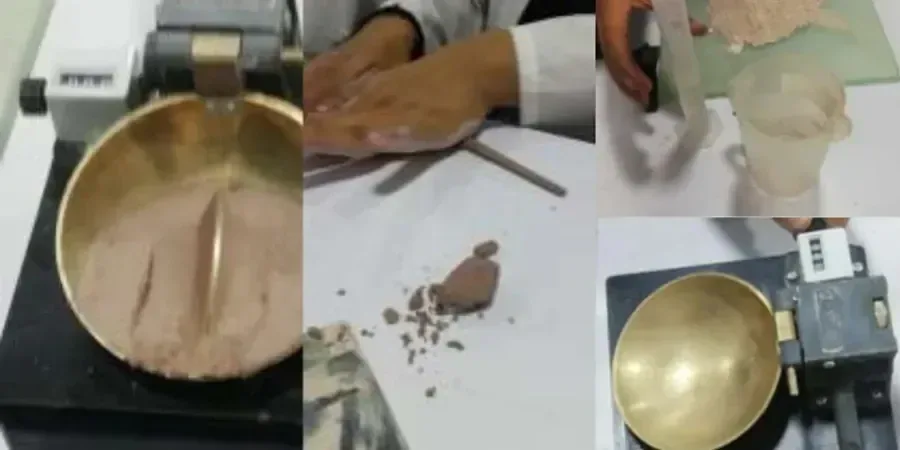
The brass cup drops 25 times in a steady rhythm on our lab bench right here in Rancho Cucamonga. You hear it before you see it—a mechanical cadence that means the liquid limit test is running. We work with the Casagrande percussion device and a set of glass plates for the plastic limit thread-rolling procedure, following ASTM D4318 to the letter. These aren't abstract numbers; for any Rancho Cucamonga project, the liquid limit, plastic limit, and plasticity index define how the soil will behave when it gets wet, which matters a lot on the alluvial fans that slope down from the San Gabriel Mountains. We run the full procedure in our temperature-controlled lab, because even a few degrees of drying can shift the results and lead to a wrong classification. When you combine this data with a grain size analysis, you get the full Unified Soil Classification System (USCS) picture needed for foundation reports.
A five-percent shift in plasticity index can change the site classification from CL to MH, which alters the entire foundation recommendation for a Rancho Cucamonga hillside lot.
Scope of work
Area-specific notes
Rancho Cucamonga grew fast in the 1970s and 1980s, when the old vineyards and citrus groves gave way to subdivisions and commercial pads. A lot of those early geotechnical reports classified soils based on visual-manual methods alone, without Atterberg testing. Today, we still see projects where undocumented fill was placed over natural alluvium, and the plasticity of that fill can be completely different from the native material underneath. The risk shows up as differential heave across a slab, cracked stem walls, or retaining wall distress after a few wet winter seasons. When the Cucamonga Fault produces ground motion during a seismic event, plastic silts and clays can lose strength through cyclic softening, even if they do not fully liquefy. That scenario is not hypothetical here—the USGS Quaternary fault database maps multiple strands through the northern part of the city, and site-specific response depends heavily on the plasticity characteristics of the upper 30 feet of soil. Getting the Atterberg numbers right is the first step in a defensible foundation design.
Standards used
ASTM D4318-17e1: Standard Test Methods for Liquid Limit, Plastic Limit, and Plasticity Index of Soils, ASTM D2487-17: Standard Practice for Classification of Soils for Engineering Purposes (Unified Soil Classification System), ASCE 7-22 Chapter 20: Site Classification Procedure for Seismic Design (uses PI as input for Site Class D and E distinctions)
Linked services
Full Atterberg Suite (LL, PL, PI)
Complete liquid limit, plastic limit, and plasticity index determination per ASTM D4318. Includes plasticity chart plotting and USCS classification. Standard turnaround is 3 business days; rush service available for Rancho Cucamonga projects on tight construction schedules.
Atterberg + Hydrometer Combo
Combined testing package that pairs plasticity limits with particle-size distribution by hydrometer (ASTM D7928). Ideal for fine-grained soils common in the Rancho Cucamonga alluvial deposits, where silt and clay proportions directly affect drainage and heave potential.
Expansive Soil Screening
Uses Atterberg results plus percent passing No. 200 sieve to evaluate expansion potential per the Holtz & Gibbs method and the Seed, Woodward & Lundgren criteria. Critical for slab-on-grade projects in Rancho Cucamonga neighborhoods with known expansive soil history.
Soil Shear Strength Correlation
Provides undrained shear strength estimates from liquidity index correlations and remolded strength from plasticity data. Useful for preliminary slope stability screening in the foothill areas of Rancho Cucamonga before committing to more expensive triaxial testing.
Typical parameters
Common questions
What do Atterberg limits actually tell me about my Rancho Cucamonga building site?
They tell you how your soil behaves when moisture changes. The liquid limit marks the water content where the soil transitions from a plastic solid to a viscous liquid. The plastic limit is the moisture level where it stops being moldable and starts crumbling. The difference between them—the plasticity index—is a direct indicator of how much volume change you can expect when the soil gets wet. In Rancho Cucamonga, where summer irrigation and winter rains create seasonal moisture cycles, a soil with PI above 25 can produce enough heave to crack slabs and bind doors. We use these numbers to assign a USCS classification (CL, CH, MH, etc.) and to estimate expansion potential using established correlation charts. If your PI comes back above 30, you are almost certainly looking at some form of moisture control or structural floor design.
How long does Atterberg testing take, and do you need undisturbed samples?
Standard turnaround is three business days from sample delivery to report. We can expedite to next-day for an additional fee if your Rancho Cucamonga project is on a tight timeline. The good news is that Atterberg tests are run on remolded, disturbed samples, so you do not need expensive Shelby tubes or undisturbed sampling. We can work with jar samples, bag samples, or cuttings from your drill rig or test pit. About 250 grams of material passing the No. 40 sieve is plenty for a full LL and PL determination. Just make sure the sample is representative of the stratum you need classified and has not dried out completely in a bucket on the site trailer for two weeks.
How much does Atterberg limits testing cost in Rancho Cucamonga?
A standard liquid limit and plastic limit pair runs between US$70 and US$90 per sample in our Rancho Cucamonga lab. That includes the plasticity index calculation, USCS classification, and a brief interpretive note. If you bundle multiple samples from the same project, we can usually offer a volume discount. The price covers the full ASTM D4318 procedure with documentation suitable for city building department submittals. Expedited turnaround or testing on samples that require extensive pre-processing (like removing organic matter or heavy gravel content) may carry a small surcharge.
Can Atterberg limits predict whether my Rancho Cucamonga soil will liquefy in an earthquake?
Not directly, but they provide essential input for liquefaction susceptibility screening. The Chinese criteria and the more recent Bray-Sancio approach both use the plasticity index and the liquid limit to distinguish between clay-like soils that are not susceptible to liquefaction and silt-like soils that may be. A soil with PI above 12 to 15 and LL above 35 is generally considered non-liquefiable under most screening frameworks. For Rancho Cucamonga sites near the Cucamonga Fault, this determination matters because it can eliminate the need for expensive CPT-based liquefaction analysis if the Atterberg data clearly places the soil in the non-susceptible range. If the PI comes back low and the soil plots as an ML silt, you will want to proceed with a full liquefaction assessment.