The alluvial fan deposits at the base of the San Gabriel Mountains create challenging conditions for shallow foundations in Rancho Cucamonga. Loose sands and soft silts are common across the city, especially east of the I-15 corridor. Standard fill-and-compact methods often fall short when the water table is within 3 meters of the surface. We design stone column arrays that densify the surrounding soil and provide vertical drainage, reducing liquefaction risk in a city where peak ground acceleration can reach 0.8g. A CPT test ahead of the design phase gives us a continuous profile of tip resistance and sleeve friction, which directly feeds into the Priebe method for settlement calculation. When the site is accessible, we combine this with a test pit inspection to verify the grain size distribution against the vibro-replacement compatibility criteria.
A well-designed stone column grid in Rancho Cucamonga can cut post-construction settlement by half while providing a drainage path that mitigates pore pressure buildup during earthquakes.
Scope of work
Area-specific notes
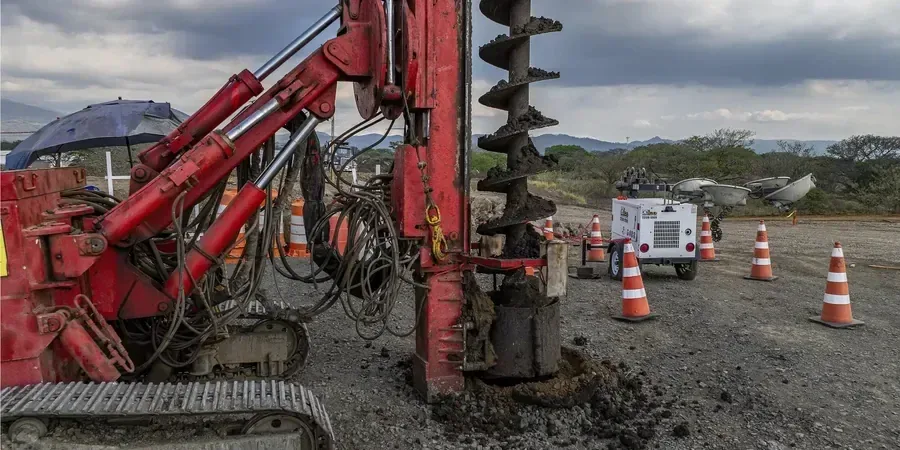
A crane-mounted vibroflot with a 130 kW hydraulic power pack is the core equipment for stone column installation in Rancho Cucamonga. The probe must penetrate the full depth of the soft layer and form a bulb at the base. The main risk is necking—when the column diameter shrinks in the middle due to lateral squeezing from saturated silts. We mitigate this by controlling the withdrawal rate and monitoring amperage in real time. Another local issue is cobble-rich lenses in the alluvium. These can deflect the vibroflot and create irregular columns. Pre-drilling through these obstructions is sometimes required. We also design the pad elevation to prevent crushed stone contamination from surface runoff during the rainy season, which runs from November to March in this part of San Bernardino County.
Watch how it works
Standards used
FHWA-NHI-10-016 Improvement Methods (Vol. II), ASTM D1586-18 Standard Test Method for SPT, IBC Chapter 18 Soils and Foundations
Linked services
Feasibility and Preliminary Design
We assess soil gradation, fines content, and groundwater level to confirm vibro-replacement compatibility. Deliverables include column spacing, depth, and estimated settlement reduction.
Final Design and Quality Control Plan
We produce signed and stamped drawings with column layout, installation sequence, stone specifications, and post-treatment testing requirements. The plan includes acceptance criteria based on modulus or SPT improvement.
Typical parameters
Common questions
What does stone column design cost in Rancho Cucamonga?
Engineering fees for a stone column design package typically range from US$1.530 to US$5.610, depending on the treated area and the number of verification tests required by the city.
How deep do stone columns need to go in Rancho Cucamonga?
Most designs target 8 to 15 meters to penetrate the loose alluvial layer and seat the column in competent material. The exact depth is determined by CPT refusal or an SPT N-value above 30.
Does stone column design include liquefaction analysis?
Yes. We run a SPT- or CPT-based liquefaction triggering analysis using the NCEER/Youd-Idriss method. The stone column array is then designed to reduce excess pore pressure through drainage and densification.