Contractors working the alluvial fan deposits north of Foothill Boulevard know that Rancho Cucamonga subgrades can shift from decomposed granite to silty sand within a single trench. The California Bearing Ratio (CBR) test — soaked per ASTM D1883 — tells the pavement designer whether that material will pump fines under traffic or hold its strength through wet winters. Between the 2019 Greenway extension and recurring industrial park builds near the 10/15 interchange, the laboratory CBR value has become the first number geotechnical reviewers check before approving structural section reductions. When the soaked CBR drops below 5%, we usually pair the result with a grain-size analysis to confirm fines content, and a proctor curve to lock in the compaction target before the first lift goes down.
A four-day soaked CBR value captures the worst-case scenario that a 72-hour atmospheric river event imposes on Rancho Cucamonga subgrades — and that is the only number that should drive pavement thickness design.
Scope of work
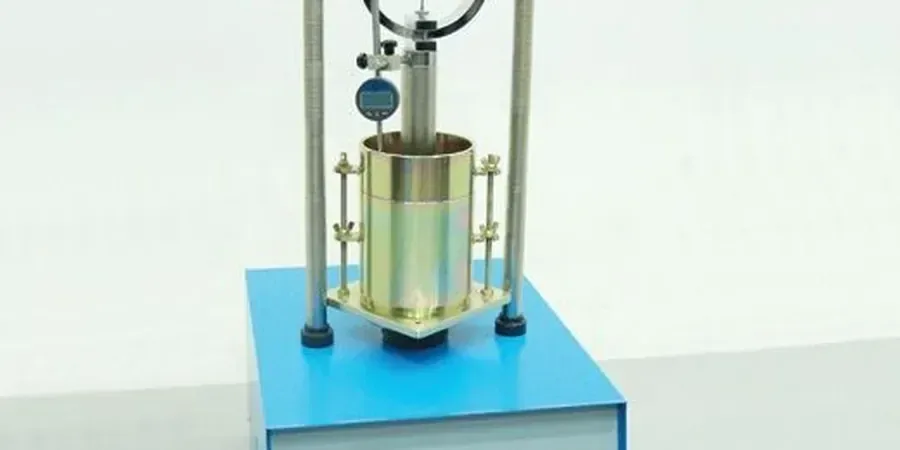
Area-specific notes
A 350,000-square-foot logistics center off Etiwanda Avenue was designed with a pavement structural section assuming a design CBR of 15. The geotechnical report flagged the onsite material as silty sand (SM), but laboratory CBR testing on recompacted specimens after four days of soaking delivered a value of 6. The difference translated into an additional 4 inches of aggregate base across the entire truck court — a six-figure change order absorbed before the first panel was poured. Rancho Cucamonga sits on Quaternary alluvial deposits where thin lenses of fat clay (CH) can be interbedded with clean sand. If the contractor samples only the granular layer and skips the laboratory CBR on the worst stratum, the pavement section is optimized for a material that does not represent the formation. Caltrans Section 608 requires the design CBR to reflect the weakest 12-inch subgrade horizon within the top 3 feet — and that determination can only come from a soaked laboratory test, not a DCP correlation.
Standards used
ASTM D1883-21: Standard Test Method for California Bearing Ratio (CBR) of Laboratory-Compacted Soils, AASHTO T 193-22: Standard Method of Test for the California Bearing Ratio, Caltrans Highway Design Manual Chapter 630: Flexible Pavement Design, ASTM D1557-12: Standard Test Methods for Laboratory Compaction Characteristics of Soil Using Modified Effort
Linked services
Soaked Laboratory CBR (ASTM D1883 / AASHTO T 193)
Complete four-day test program on 6-inch molds compacted at specified moisture-density conditions. Includes swell measurement, load-penetration curve correction, and CBR report at 0.1 and 0.2 inches. Suitable for Caltrans flexible pavement design and subgrade acceptance.
CBR plus Companion Index Testing Package
Combined test series including one-point Proctor, grain-size distribution (sieve and hydrometer), Atterberg limits, and R-value estimation. Delivers the full dataset required for mechanistic-empirical pavement design and subgrade correction calculations.
Typical parameters
Common questions
What does the laboratory CBR test cost in Rancho Cucamonga?
A single-point soaked CBR test per ASTM D1883 runs US$120 to US$190, depending on whether companion moisture-density data is required. The price includes specimen preparation at modified Proctor effort, four-day soaking with swell monitoring, and the penetration test with corrected load-penetration curve.
How long does the lab CBR test take from sample delivery to report?
The standard soaked CBR procedure requires a minimum of five working days: one day for compaction and setup, four days (96 hours) of submersion under surcharge, and one day for penetration testing and reporting. Expedited schedules are possible when the design team coordinates sample delivery with our lab calendar.
Can you run the CBR test on soil with gravel larger than 3/4 inch?
ASTM D1883 limits particle size to 3/4 inch (19 mm) for the standard 6-inch mold. Material with oversize gravel is scalped on the No. 4 sieve, and the plus-No. 4 fraction is replaced with an equal mass of retained material per AASHTO T 193 Section 6.2. The report flags the scalping percentage so the designer can assess its effect on the field CBR.
Is the laboratory CBR value the same as the field CBR or DCP value?
No. The laboratory CBR is measured on a specimen compacted at a controlled moisture and density, usually near optimum, and soaked for four days — it represents the worst-case saturated subgrade condition. Field CBR or DCP tests measure in-situ conditions that may be drier and denser. For pavement thickness design, Caltrans relies on the laboratory soaked CBR as the conservative baseline.