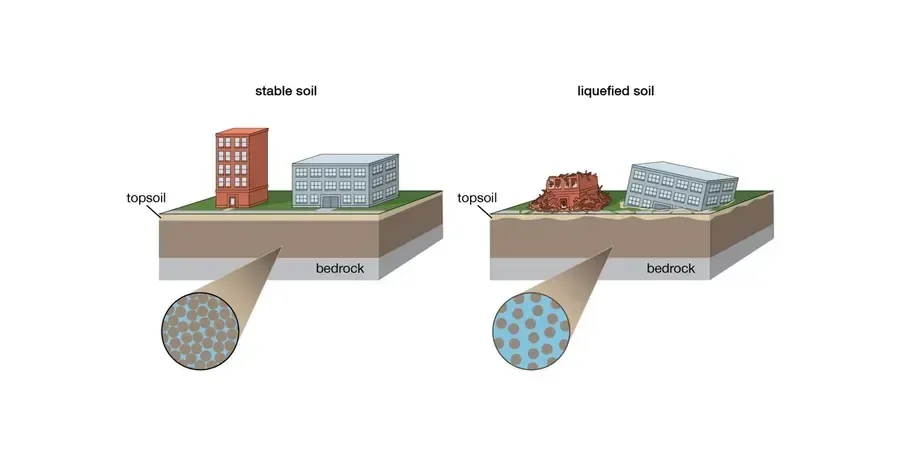
Rancho Cucamonga sits at roughly 1,200 feet elevation against the San Gabriel Mountains, but the real concern for any builder here lies about 30 kilometers east—the San Jacinto Fault. That fault produced a M6.7 in 1918 and keeps the alluvial fans beneath the city under constant seismic scrutiny. A soil liquefaction analysis moves beyond standard bearing capacity checks to examine how loose, saturated silts and sands respond when strong shaking hits. In our experience across the Inland Empire, even sites that look dry on the surface can hide perched water tables that completely change the liquefaction susceptibility classification. The IBC Chapter 18 provisions require this evaluation whenever the mapped spectral acceleration exceeds certain thresholds, and most of Rancho Cucamonga falls within zones where the analysis is not optional.
The loose alluvial sands at 15 to 35 feet depth, combined with a shallow water table, create the classic liquefaction scenario that Seed and Idriss first documented.
Scope of work
Area-specific notes
The semi-arid climate of Southern California masks a subsurface reality that catches unprepared developers off guard. Rancho Cucamonga receives barely 17 inches of rain annually, yet irrigation return flows and periodic stormwater recharge keep the groundwater mound surprisingly high across the southern half of the city. A developer who skips the liquefaction analysis because the site looks dry is betting against the pore pressure response that occurs within seconds of strong shaking. What we have observed after the Ridgecrest sequence in 2019—even at this distance—is that pore pressure buildup can initiate in sand layers that were not visibly saturated during drilling, simply because seasonal fluctuations and perched water create temporary saturation zones. The consequence is not just bearing failure; lateral spreading toward the gentle slopes descending toward the Santa Ana River basin can tear apart slab-on-grade foundations and underground utilities. The IBC explicitly ties the analysis requirement to Site Class determination, and the alluvial soils here rarely classify better than Site Class D without deep shear wave velocity testing.
Standards used
IBC 2024 Chapter 18 (Soils and Foundations), ASCE 7-22 Section 11.8 Liquefaction Triggering, ASTM D1586-18 Standard Test Method for SPT, ASTM D2487-17 Practice for Soil Classification, NCEER/NSF (Youd & Idriss 2001) Triggering Correlation, ASTM D5778-20 Standard Test Method for CPT
Linked services
SPT-Based Liquefaction Triggering Analysis
We drill through the critical alluvial layers, perform SPT at 2.5-foot intervals, and calculate cyclic stress ratio (CSR) versus cyclic resistance ratio (CRR) using the NCEER procedure. The report includes liquefaction potential index (LPI) mapping and post-liquefaction settlement estimates for your structural engineer.
CPT and Laboratory Confirmation Testing
For sites with complex stratigraphy or where SPT disturbance is a concern, we deploy cone penetration testing to capture continuous tip resistance and friction ratio data. All samples undergo fines content (ASTM D1140) and Atterberg limits testing to confirm the susceptibility classification and refine the CRR curve selection.
Typical parameters
Common questions
What triggers the requirement for a liquefaction analysis in Rancho Cucamonga?
Per IBC 2024 Section 1803.5.12, a liquefaction evaluation is required when the site is mapped within Seismic Design Category D, E, or F and the groundwater table is within 50 feet of the surface. Most of Rancho Cucamonga falls under SDC D due to proximity to the San Jacinto and San Andreas fault systems. The analysis must assess triggering and consequences such as settlement and lateral spreading.
How deep do you drill for a liquefaction assessment here?
We typically extend borings to a minimum of 50 feet below grade, or until we penetrate through all potentially liquefiable strata and encounter competent material. In Rancho Cucamonga, the loose alluvial sand layer usually terminates against older, denser Pleistocene deposits between 40 and 55 feet, which serves as a natural boundary for the analysis.
What is the cost range for a soil liquefaction analysis in Rancho Cucamonga?
Depending on the number of borings, depth, and whether CPT is required, a complete liquefaction study in Rancho Cucamonga ranges from US$2,170 to US$3,980. The scope includes field investigation, laboratory testing for fines content and plasticity, CSR-CRR calculations, and a signed report with LPI maps and settlement estimates.
How long does the analysis take from start to report delivery?
Field work typically takes two to three days for a standard commercial lot. Laboratory testing requires approximately one week for sieve and hydrometer analysis plus Atterberg limits. The numerical modeling and report preparation add another week. Overall, clients receive the final signed report within three to four weeks of mobilization.
Can you perform the analysis if the groundwater level is deep?
Yes, and in fact it may simplify the evaluation. If groundwater is deeper than 50 feet across the design life of the structure, liquefaction may be ruled out for those strata. However, in Rancho Cucamonga we often find perched water tables at shallower depths even when the regional aquifer is deep, so we always install a piezometer to confirm the seasonal high water level before concluding that saturated conditions do not exist.