ASTM D6913 and D7928 define the standard procedures for particle-size distribution, and in Rancho Cucamonga those procedures are not just a formality. The city stretches from the alluvial fan of Deer Creek up toward the San Gabriel foothills, so a single jobsite can shift from clean gravels to silty fines within a few hundred feet. Our laboratory combines mechanical sieving for the coarse fraction with a hydrometer analysis for material passing the No. 200 sieve, delivering a continuous curve that informs USCS classification, permeability estimates, and compaction behavior. For deeper exploration we often pair the gradation data with SPT drilling to correlate grain-size trends with blow counts, and when fines content exceeds 15 percent we run Atterberg limits on the same sample to confirm the plasticity characteristics required by IBC Chapter 18.
A full sieve-plus-hydrometer curve on Rancho Cucamonga alluvium often reveals a gap-graded architecture that standard well-graded assumptions miss entirely.
Scope of work
Area-specific notes
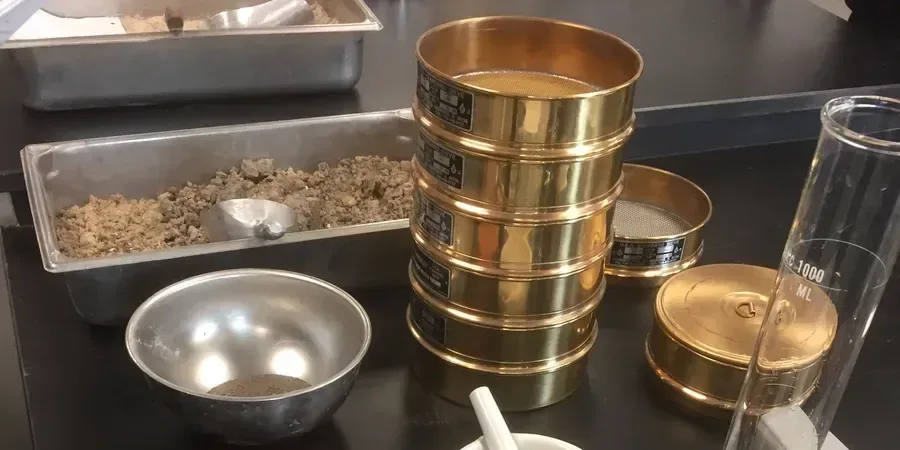
The hydrometer sedimentation cylinder and the stacked sieve assembly are simple devices, but the error budget in Rancho Cucamonga's variable alluvium can be unforgiving. Hydrometer readings taken without temperature correction in a lab that fluctuates between 15 and 25 degrees Celsius will shift the clay fraction by several percentage points, and that shift can change the USCS classification from silty sand to clayey sand, triggering different seismic site class assumptions under ASCE 7. We run duplicate hydrometer tests whenever the percent passing No. 200 exceeds 12 percent, and we oven-dry the washed fraction to constant mass rather than relying on a single weighing. Inadequate dispersion of clay platelets is the most common source of bias: our protocol extends the mixing time beyond the minimum when the soil shows high plasticity, ensuring the measured distribution reflects particle size, not flocculation.
Standards used
ASTM D6913-17: Standard Test Methods for Particle-Size Distribution of Soils, ASTM D7928-21: Standard Test Method for Particle-Size Distribution of Fine-Grained Soils Using Hydrometer, AASHTO T 88: Particle Size Analysis of Soils, ASTM D2487-17: Standard Practice for Classification of Soils for Engineering Purposes (USCS)
Linked services
Sieve Analysis Package (ASTM D6913)
Mechanical shaking through a full sieve stack from coarse gravel to fine sand, including wash-through of the No. 200 fraction. Delivers the coarse-side gradation curve, Cu, Cc, and gravel-sand split.
Hydrometer Analysis (ASTM D7928)
Sedimentation-based measurement of silt and clay fractions using a Type 152H hydrometer, with temperature, meniscus, and dispersant corrections applied per the standard.
Combined Grain Size + Atterberg Report
A unified report merging sieve data, hydrometer results, and Atterberg limits on the same sample, yielding a complete USCS classification and supporting liquefaction screening per Youd-Idriss 2001.
Typical parameters
Common questions
How much does a grain size analysis (sieve plus hydrometer) cost for a Rancho Cucamonga project?
Depending on the number of samples and whether you need the full combined package or just the sieve portion, the range typically falls between US$100 and US$190 per sample. Volume pricing applies for larger grading or subdivision investigations.
What sample mass do you need from the field for a reliable hydrometer test?
For sandy soils we request at least 500 grams of material passing the No. 10 sieve; for silt-clay soils, 50 grams of the minus-No. 40 fraction is sufficient. The sample must be oven-dried and gently disaggregated before delivery to avoid altering the natural grain-size distribution.
Why does the hydrometer analysis matter if the soil is mostly sand?
Even 8 to 12 percent fines can control permeability and frost susceptibility, and in Rancho Cucamonga many alluvial sands carry just enough silt to shift the USCS classification. ASCE 7 site-class determination also hinges on the fines content, so skipping the hydrometer can lead to an incorrect seismic design category.
How quickly can you turn around a grain-size report for a grading inspection?
Standard turnaround is three business days. We can expedite to 24 hours for time-sensitive fill-control decisions, provided the sample arrives before noon and the hydrometer run is compatible with the overnight sedimentation period.