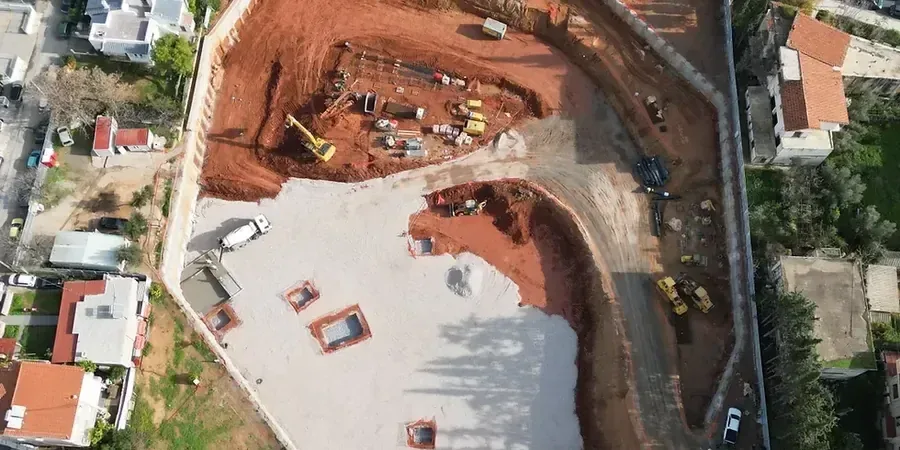
Excavating near the Terra Vista Town Center is a different animal than cutting into the older alluvial fans north of the 210. In Rancho Cucamonga, the transition from coarse bouldery deposits in the foothills to finer silty sands in the southern basin happens within a few blocks. That variability means a one-size-fits-all excavation plan is a liability. We combine local drilling data with CPT testing to map these transitions before the first bucket hits the ground. The city sits at the toe of the San Gabriel Mountains, where flash flood deposits have laid down lenses of open-work gravel that can collapse or ravel during benching. A deep excavation here is a groundwater puzzle as much as a structural one: perched water tables trapped by clay lenses can appear ten meters above the regional aquifer. We design earth retention systems that account for these perched zones, using inclinometer and piezometer monitoring to validate our assumptions during construction.
In Rancho Cucamonga's alluvial fans, a perched water table can appear 30 feet above the regional aquifer — miss it in the investigation and you'll be dewatering a slope failure.
Scope of work
Area-specific notes
IBC 2021 Section 1803.5.11 requires a specific geotechnical investigation for any excavation deeper than 12 feet. In Rancho Cucamonga, the added risk comes from the proximity of the San Jacinto and Cucamonga fault zones: strong ground motion can turn a stable vertical cut into a flowing mass if the soil has liquefiable fines. The city's soil profiles often show interbedded sands and silts that, under cyclic loading, can lose effective stress and trigger lateral spreading toward the excavation. We run site-specific response analyses using DEEPSOIL or equivalent software, not just the default ASCE 7 site coefficients, to capture amplification effects from the deep basin geometry. The second major risk is groundwater: the Cucamonga Basin's managed recharge operations can raise the water table seasonally. A design based on a summer drilling program may be dangerously optimistic for a winter excavation. Our reports always include a seasonal groundwater sensitivity analysis.
Watch how it works
Standards used
IBC 2021 Chapter 18 — Soils and Foundations, ASCE 7-22 Chapter 11 — Seismic Design Criteria, ASTM D1586-18 — Standard Test Method for Standard Penetration Test (SPT), ASTM D5778-20 — Standard Test Method for Electronic Friction Cone and Piezocone Penetration Testing, AASHTO LRFD Bridge Design Specifications, 9th Ed. — Section 11 (Abutments, Piers, and Walls), OSHA 29 CFR 1926 Subpart P — Excavations
Linked services
Excavation Feasibility & Shoring Design
We evaluate the maximum feasible cut depth for your site using limit equilibrium and finite element analyses, then design the shoring system — soldier piles with tiebacks, cantilever walls, or internally braced cuts — with full structural calculations sealed by a California-licensed geotechnical engineer.
Dewatering & Groundwater Control Plan
For excavations extending below the perched or regional water table, we design dewatering well arrays, calculate drawdown radius of influence, and prepare a groundwater control plan that meets Santa Ana Regional Water Board requirements for discharge.
Construction-Phase Monitoring & Instrumentation
We install inclinometers, piezometers, and settlement points around the excavation perimeter, and provide weekly data reports with trigger-level alerts for lateral movement or water level changes that exceed design assumptions.
Typical parameters
Common questions
How much does a geotechnical excavation design package cost in Rancho Cucamonga?
For a typical commercial excavation in the city, the combined investigation, laboratory testing, and earth retention design package ranges from US$2,050 to US$8,510, depending on depth, proximity to adjacent structures, number of borings or CPT soundings required, and whether groundwater control design is included. A shallow 15-foot cut with good access falls on the lower end; a deep basement near the Rancho Cucamonga Epicenter with tieback design and seismic analysis falls on the higher end.
What is the difference between a soldier pile wall and a soil nail wall for Rancho Cucamonga soils?
Soldier pile and lagging walls work well in the city's coarse alluvial soils where you can drill H-beams into granular material and place lagging as you excavate downward. Soil nail walls require the ground to stand unsupported for short periods while bars are drilled and grouted, which is feasible in the silty cemented deposits found in parts of the Cucamonga fan but problematic in loose clean sand or open-work gravel layers. The choice depends on the stand-up time of the soil, which we evaluate with test pit observations and CPT pore pressure dissipation data.
Do I need a separate structural engineer for the shoring, or does the geotechnical report cover it?
The reference range for this service in Rancho Cucamonga is US$2.050 - US$8.510. The final price depends on the project scope and volume.