Drive from the older, established neighborhoods north of Foothill Boulevard down to the newer commercial developments around Victoria Gardens, and the ground beneath your tires tells a story. Up north, closer to the alluvial fans spilling out of the San Gabriel Mountains, you often find coarser, rockier material that drains well. Head south toward the 210 freeway, and the soil transitions into finer silts and clays that hold moisture and expand noticeably with the winter rains. These contrasts matter when you are designing a rigid pavement that has to stay flat and crack-free for 30 years. In our experience with Rancho Cucamonga projects, a concrete pavement specification written without understanding these micro-zones is a specification headed for trouble. The city sits on a complex alluvial plain where soil stiffness can change within a single parcel, and that directly impacts the required slab thickness, joint spacing, and subbase reinforcement for any rigid pavement design. We frequently link the soil investigation with a CBR road test to calibrate the support values before locking in the concrete mix design.
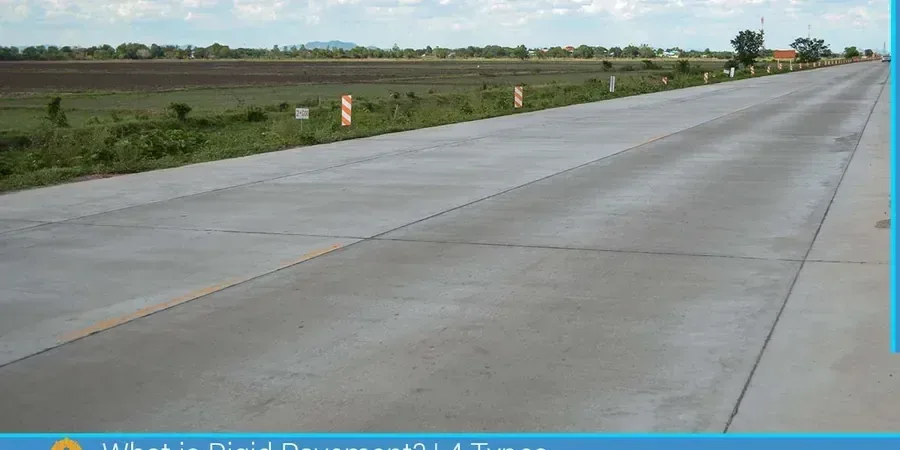
A rigid pavement in Rancho Cucamonga is a structural slab that must handle curling stresses from 100°F temperature swings and still support fully loaded semi-trucks without faulting.
Scope of work
Area-specific notes
A warehouse distribution center off Etiwanda Avenue had its loading dock approach slabs replaced after just four years of operation. The original design used plain concrete panels with no dowel bars at the contraction joints, and the subbase was a thin layer of untreated aggregate over silty clay. Under repeated forklift traffic and container truck turning movements, the slabs pumped the fines from the subgrade through the open joints, creating voids under the corners. Within two rainy seasons, the corner breaks were deep enough to snag pallet jacks. The repair involved full-depth replacement, installation of epoxy-coated dowels for positive load transfer, and the addition of a cement-stabilized subbase to control the pumping mechanism. This case illustrates why the joint system and the subbase drainage layer are not optional extras in Rancho Cucamonga: they are the difference between a pavement that serves for decades and one that fails prematurely. The combination of heavy commercial traffic along the I-15 corridor and the moisture-sensitive soils demands a design that actively manages water and distributes edge loads across adjacent panels.
Standards used
AASHTO 93 Guide for Design of Pavement Structures, ASTM C78 / C78M Standard Test Method for Flexural Strength of Concrete, ASTM D2487 Standard Practice for Classification of Soils for Engineering Purposes, ACI 360R Guide to Design of Slabs-on-Ground, Caltrans Highway Design Manual Chapter 600
Linked services
Concrete Pavement Structural Design
We develop the complete pavement structure including slab thickness, reinforcement requirements, joint layout, and subbase specifications using AASHTO 93 procedures calibrated for the local climate and subgrade conditions of Rancho Cucamonga.
Subgrade and Subbase Evaluation
Before any concrete is poured, we run in-situ density tests, plate load tests for the modulus of subgrade reaction (k-value), and proof-rolling to verify uniform support across the entire footprint of the pavement area.
Typical parameters
Common questions
What is the typical service life of a rigid pavement in Rancho Cucamonga?
A properly designed and constructed rigid pavement in this region should deliver 30 to 40 years of service with minimal maintenance. The actual lifespan depends on the accuracy of the traffic load projections, the quality of the subbase drainage, and whether the joint sealing program is maintained over time to prevent water infiltration into the subgrade.
How do the expansive soils in southern Rancho Cucamonga affect rigid pavement?
Expansive clays can cause differential heave under the slab edges during wet months and shrinkage during dry months, leading to loss of support and corner cracking. We mitigate this by deepening the subbase layer, using moisture-treated or cement-stabilized subgrade, and ensuring positive drainage away from the pavement edges to minimize moisture fluctuation cycles.
What is the cost range for a rigid pavement design package?
For a typical commercial or light industrial project in Rancho Cucamonga, the design package including subgrade investigation, pavement structural design, and construction specifications falls between US$1,670 and US$6,780, depending on the total paved area and the complexity of the soil conditions encountered.
Do you handle Caltrans and City of Rancho Cucamonga submittal requirements?
Yes. We prepare the pavement design report and supporting calculations to meet the requirements of both the City of Rancho Cucamonga Public Works Department and Caltrans District 8, including the mandatory subgrade soil reports, design life justification, and traffic index computations where applicable.