At 1,210 feet of elevation, Rancho Cucamonga sits squarely on the enormous alluvial fan of Cucamonga Creek. The city has grown from vineyard colonies into a logistics and residential hub of over 175,000 people, pushing development onto slopes that used to be seasonal flood channels. When a project lands on these young, unconsolidated deposits, retaining wall design becomes an early-stage constraint, not an afterthought. The September 2024 Malibu Hills earthquake reminded many owners that even a moderate event can trigger lateral movement in poorly drained backfill. We usually start by correlating site borings with the CPT test to map continuous soil profiles, then compare those results with the slope stability analysis before selecting an appropriate wall system. The Cucamonga Fault runs just north of the city, so the team always checks for fault-rupture setback zones before laying out any wall alignment.
Retaining wall design on alluvial fans demands more than a standard section: you need continuous drainage, seismic ductility, and a clear understanding of where water is going to go.
Scope of work
Area-specific notes
Rancho Cucamonga experiences a semi-arid climate with 17 inches of annual rainfall concentrated between December and March, while summer temperatures routinely exceed 100°F. This cycle of dry cracking followed by sudden saturation is hard on retaining walls: the soil shrinks and swells, opening paths for water to reach the wall back face. On a recent project near Etiwanda Avenue, we found that a 14-foot gravity wall had accumulated nearly 3 feet of water behind it within one week of a storm, simply because the weep holes had clogged with fine sand. The fix involved coring new drains and installing a grouting curtain to reduce seepage from an uphill irrigation canal. Ignoring these seasonal extremes leads to stalactite-like efflorescence, corroded rebar, and eventually a service-life reduction of 30 percent or more.
Watch how it works
Standards used
ASCE 7-22 (Minimum Design Loads for Buildings and Other Structures), IBC 2021 (International Building Code, Chapter 18), ASTM D1586-18 (Standard Test Method for SPT), ASTM D2487-17 (Classification of Soils for Engineering Purposes), AASHTO LRFD Bridge Design Specifications (retaining wall sections)
Linked services
Geotechnical Investigation for Wall Design
Borings, SPT, and CPT soundings to define stratigraphy, shear strength, and groundwater depth. We prepare a bearing-capacity and sliding-stability report with wall-type recommendations (gravity, cantilever, MSE, or anchored) based on the City of Rancho Cucamonga grading ordinance.
Structural Design and Construction Observation
Reinforced-concrete wall sections, drainage details, and backfill specifications prepared under the 2021 IBC. During construction we observe footing subgrade, reinforcement placement, and backfill compaction to confirm compliance with the approved plans.
Typical parameters
Common questions
What type of retaining wall works best for Rancho Cucamonga's alluvial soils?
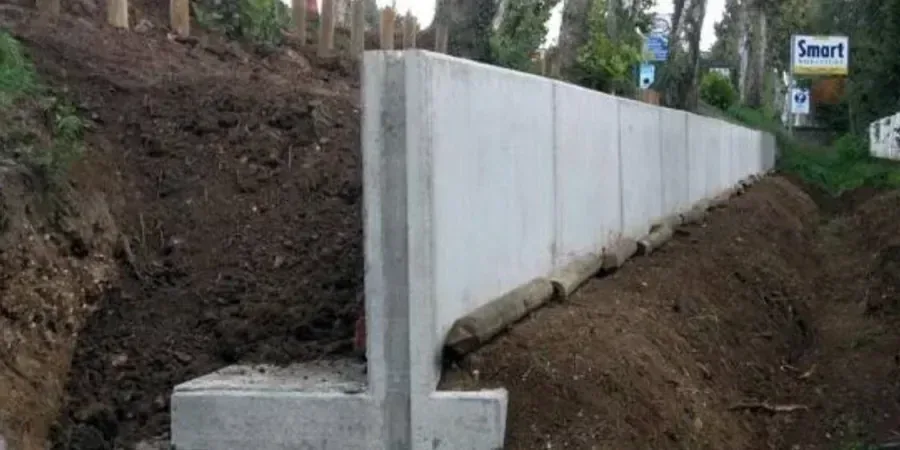
It depends on the height and the setback. For walls under 6 feet, segmental block walls with geogrid reinforcement often perform well if the foundation is keyed into competent material. For taller walls, reinforced-concrete cantilever or counterfort designs are more common because they handle the low-cohesion silty sand better. We always pair the structural choice with a solid drainage system, open-graded backfill, and a filter fabric to keep the fines from migrating into the drain.
How much does a retaining wall design typically cost in Rancho Cucamonga?
For a typical single-family residential wall in the area, the geotechnical investigation and structural design package usually falls between US$1,150 and US$3,770, depending on wall height, access constraints, and whether borings or CPT soundings are needed. Commercial projects with multiple wall tiers and shoring requirements run higher because of the additional analysis and city review cycles.
Does the city require a geologic report for retaining walls?
Yes. Rancho Cucamonga's grading ordinance typically triggers a geotechnical report for walls over 3 feet in height, and the city often asks for a fault-rupture evaluation if the site lies within the Alquist-Priolo Special Studies Zone. We coordinate with the project structural engineer to make sure the wall design addresses both the soil report and the city's standard conditions of approval.