Sitting at 1,210 feet above sea level where the Cucamonga alluvial fan spreads out from the San Gabriel Mountains, Rancho Cucamonga presents a subsurface profile that shifts dramatically within a single lot. Over our years of drilling here, we have encountered everything from clean sandy gravels near the 210 freeway to silty fine sands with cobble lenses south of Foothill Boulevard. The Standard Penetration Test (SPT) per ASTM D1586-18 remains the most practical way to map these transitions before you commit to a foundation type. When the last significant shaking from the San Andreas woke up the Inland Empire, plenty of older structures on poorly characterized ground took damage that a few well-placed SPT borings could have flagged decades earlier.
Getting N-values every 2.5 to 5 feet lets us correlate directly to friction angle and relative density using established relationships like Peck, Hanson & Thornburn, which feeds straight into bearing capacity equations under the 2022 California Building Code. For deeper profiles where refusal is a concern, we often pair the SPT with a CPT test to bridge the gap between granular and cohesive layers without losing resolution, especially when the water table shows up shallow in winter after heavy San Gabriel runoff.
A 24-inch split-spoon sample and honest blow counts tell you more about Rancho Cucamonga ground than a dozen assumptions from a geology map.
Scope of work
We also run particle-size analysis on the split-spoon samples in our grain size lab to confirm the USCS classification, which matters when the geotechnical report needs to assign lateral earth pressures for retaining walls. In the finer soils common near the old vineyards on the east side, we run Atterberg limits to rule out expansive clay behavior, and for sites with vibration-sensitive neighbors we combine SPT data with a MASW survey to get shear-wave velocity without extra disturbance.
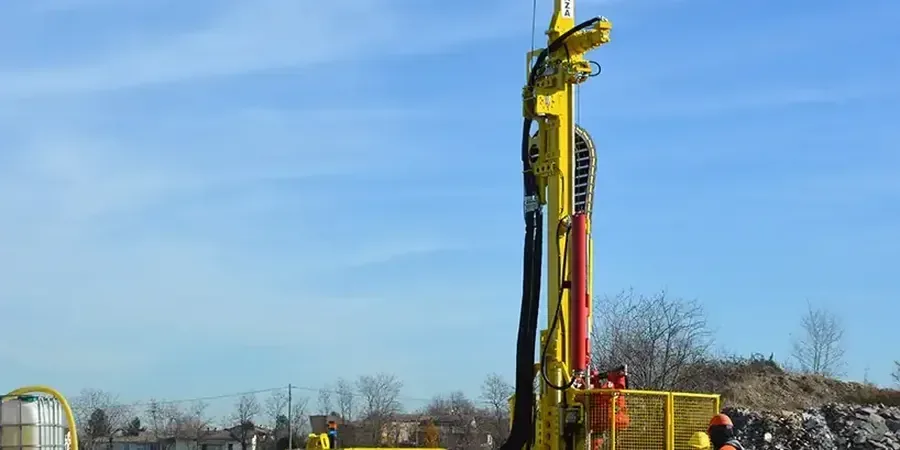
Area-specific notes
Rancho Cucamonga grew in waves — first as an agricultural outpost with shallow irrigation wells, then as a commuter suburb after the I-15 corridor took off. That layered history means our drillers are just as likely to encounter old backfill from 1950s orchard leveling as they are to hit undisturbed Pleistocene alluvium. The SPT becomes a forensic tool in these situations: sudden drops in N-value at eight or ten feet often trace back to old root zones, loose fill, or poorly compacted trench backfill from utility work that predates modern inspection codes.
Liquefaction is not just a coastal problem here; the silty sand layers we log in the lower parts of the fan, particularly south of Arrow Route where the groundwater can rise within 15 feet of the surface after wet winters, meet the gradation and saturation criteria for liquefaction susceptibility per the NCEER/Youd-Idriss framework. A single SPT borehole logged carefully and supplemented with fines content from the wash gives you the raw numbers to run a simplified procedure and decide whether Improvement is worth the cost.
Standards used
ASTM D1586-18, ASTM D2487-17e1 (USCS classification), ASTM D6066-11 (N60 energy correction), 2022 California Building Code (CBC) Chapter 18, IBC 2021 Section 1803
Linked services
SPT Drilling with N60 Energy Correction
Complete SPT boring program using a calibrated automatic hammer. We measure hammer energy ratio on-site to deliver corrected N60 values, not raw blow counts, so your geotechnical engineer can apply standard correlations without back-calculating efficiency. Includes detailed boring logs with strata descriptions per ASTM D2488.
Combined SPT and Soil Classification Package
We pair every SPT sample with grain-size distribution and Atterberg limits in our Rancho Cucamonga lab. This gives you a full USCS classification (SP, SM, CL, etc.) tied to each N-value interval, which makes seismic site class determination per ASCE 7-16 straightforward and defensible.
Typical parameters
Common questions
How deep do you typically drill SPT borings in Rancho Cucamonga?
For most commercial and residential projects, we go to 30 or 40 feet below grade, which is enough to satisfy the 2022 CBC requirement for liquefaction assessment in our seismic design category. If we hit refusal on cobbles before reaching target depth, we discuss alternatives like a CPT test to push through softer matrix or a rock coring setup.
What does an SPT test cost in Rancho Cucamonga?
For a standard program with mobilization, drilling, sampling, and N60-corrected logs, budget in the range of US$560 to US$650 per boring per day, depending on depth, access constraints, and whether we need traffic control near major arterials like Haven Avenue. Lab classification adds a per-sample rate that we quote based on your boring plan.
Can SPT data alone determine if my site has a liquefaction risk?
Yes, the Seed-Idriss simplified procedure and the NCEER workshop updates use corrected SPT N-values, fines content, and groundwater depth to calculate the factor of safety against liquefaction. We provide the N60 and gradation data; your geotechnical engineer runs the analysis. In borderline cases, a MASW survey adds shear-wave velocity as a second independent check.