ASTM D698 and D1557 define the baseline for every engineered fill inspection in Rancho Cucamonga, but getting the curve right starts with understanding what the local alluvium actually does under a tamper. The city sits on coalescing alluvial fans descending from the San Gabriel Mountains, carrying a mix of decomposed granite, angular gravels, and silty fines that behave differently at 12% moisture than at 14%. A standard Proctor run on a bulk sample from a Victoria Gardens-area pad can miss the sensitivity that shows up during a 95% relative compaction check on Monday morning. We run both standard and modified Proctor curves from the same bulk sample so the earthwork contractor knows exactly what target density the soils report specifies, and the geotechnical engineer has a defensible maximum dry density for the compaction report. Pairing the Proctor with sand cone density testing during lift placement closes the loop between the lab curve and what the nuclear gauge operator reads in the trench backfill or the building pad. For projects where the borrow source varies, we often supplement the Proctor with a grain size analysis to flag shifts in the fines content before the compaction window closes.
A Proctor curve built on the wrong moisture points is more expensive than the test itself—it writes the compaction spec the crew has to chase for the next six months.
Scope of work
Area-specific notes
A tilt-up warehouse off Milliken Avenue had the floor slab specified at 98% modified Proctor on the upper 12 inches of structural fill. The borrow material came from an onsite cut that tested well in the exploration phase, but the Proctor curve had been generated from a single bulk sample that underrepresented the cobble fraction. During the first week of pad compaction, the field density tests came back consistently low—90 to 92%—and the earthwork subcontractor was already three lifts deep. We remobilized within 48 hours, ran a modified Proctor on a composite of the material the sheepsfoot roller was actually working, and the maximum dry density shifted upward by 4.2 pcf. That recalibrated the compaction target and salvaged the lifts already placed. In the Rancho Cucamonga alluvial environment, the Proctor curve is not a one-and-done laboratory exercise. It needs to track the borrow source, and it deserves a one-point verification check every 5,000 cubic yards or whenever the color and feel of the fill change at the gate.
Watch how it works
Standards used
ASTM D698-12: Standard Test Methods for Laboratory Compaction Characteristics of Soil Using Standard Effort, ASTM D1557-12: Standard Test Methods for Laboratory Compaction Characteristics of Soil Using Modified Effort, ASTM D1557 / D698 calibration family for one-point field verification, ASTM D2487: Classification of Soils for Engineering Purposes (Unified Soil Classification System), IBC Chapter 18: Soils and Foundations — compacted fill acceptance criteria
Linked services
Standard Proctor (ASTM D698)
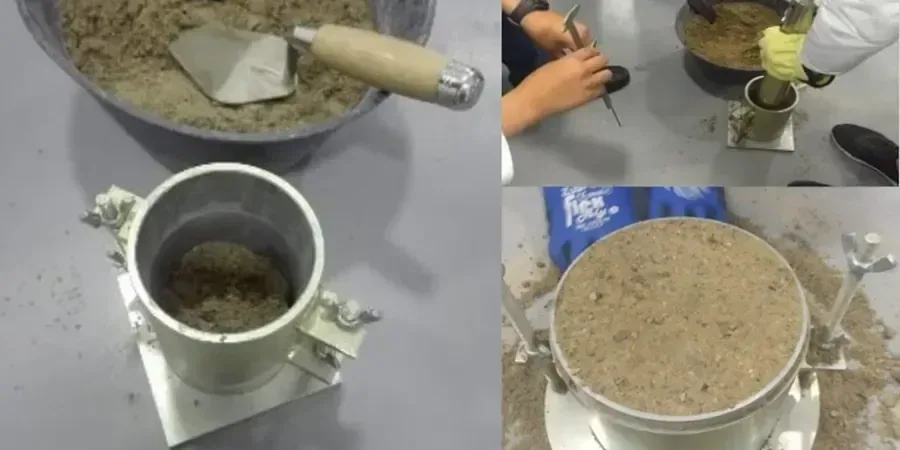
4-inch mold, 5.5-lb hammer, 12-inch drop. The reference for landscape berms, utility trench backfill, and low-rise residential pads where the structural load does not warrant modified effort.
Modified Proctor (ASTM D1557)
10-lb hammer, 18-inch drop, delivering 56,250 ft-lbf/ft³ of compactive energy. Required for structural fill beneath commercial slabs, pavement subgrade, and any fill placed under Rancho Cucamonga building department earthwork permits.
One-Point Field Verification
Rapid QC check using the project-specific Proctor family of curves. The field technician pulls a single moisture-density point and we confirm it falls on the established compaction curve, saving the contractor from full re-runs when borrow material shifts.
Combined Proctor + CBR Package
For warehouse and distribution center pavement design, we run the modified Proctor and the soaked CBR on the same remolded sample, giving the pavement engineer a consistent dataset for AASHTO 1993 structural design.
Typical parameters
Common questions
How much does a Proctor test cost in Rancho Cucamonga?
A standard or modified Proctor curve typically runs between US$110 and US$190 per sample, depending on whether it is a 4-point or 5-point curve and whether the material requires the oversize correction. Expedited same-week reporting may affect the final lab fee.
When does the City of Rancho Cucamonga require a modified Proctor instead of a standard Proctor?
The building department generally requires a modified Proctor (ASTM D1557) for structural fill supporting commercial slabs, retaining walls, and pavement subgrade. Standard Proctor (ASTM D698) is accepted for landscape fill and shallow utility bedding, but the project soils report will specify which effort applies to each lift.
How quickly can we get the Proctor curve back from the lab?
Standard turnaround on a Proctor curve is 3 to 4 working days from sample drop-off. We can often deliver results within 48 hours for active grading operations when the contractor coordinates sample delivery early in the morning. The one-point field verification can be turned around same-day when the family of curves is already established.
What happens if the fill material contains rock fragments larger than the Proctor mold?
We apply the ASTM D4718 oversize correction when the material retains more than 5% on the 3/4-inch sieve. The correction adjusts the maximum dry density and optimum moisture content of the minus-3/4-inch fraction to account for the rock fraction that does not participate in the compaction test. For material with more than 30% oversize, we recommend a large-scale compaction test or a method specification based on the rock correction curves.