IBC Chapter 18 and local Rancho Cucamonga ordinances require thorough subsurface investigation before any foundation design. On the alluvial fans spreading south from the San Gabriel Mountains, exploratory test pit excavation delivers direct visual access to soil stratigraphy that borings alone can miss. The city sits at roughly 368 meters elevation where coarse-grained debris flows interfinger with finer floodplain silts, a depositional pattern that creates abrupt lateral changes in bearing capacity. A test pit opened to three or four meters exposes these contacts clearly. Field logging under ASTM D2488 lets the geotechnical engineer identify the percentage of cobbles, the degree of cementation in older fan deposits, and any paleosol horizons that could act as preferential slip planes during a seismic event.
A three-meter exploratory test pit reveals more about soil variability on Rancho Cucamonga alluvial fans than five borings spaced twenty feet apart.
Scope of work
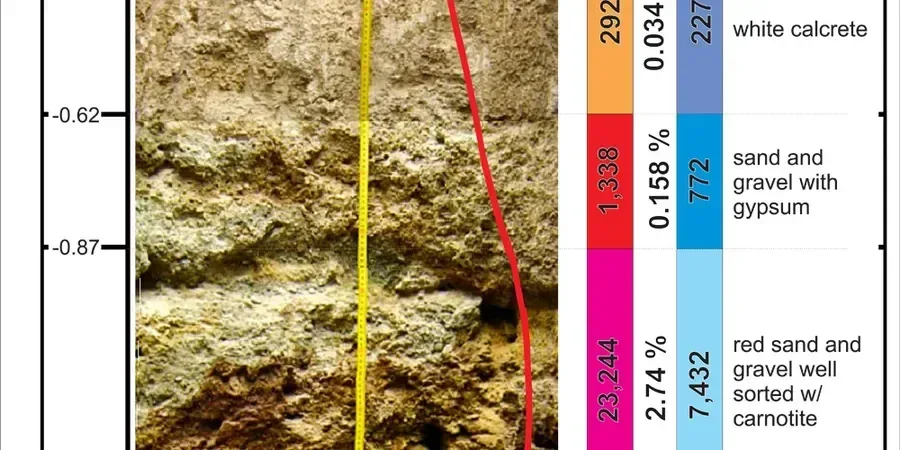
Area-specific notes
The semi-arid climate of Rancho Cucamonga — barely 430 millimeters of rain annually, most arriving in a handful of winter storms — creates a deceptive risk during exploratory test pit excavation. Surface soils look dry and competent, yet a perched water table from landscape irrigation or a leaking storm drain can soften the sidewalls without warning. Cal/OSHA classifies many of these pits as Type C soil, the least stable category, requiring benching or shoring if personnel must enter. Even outside the rainy season, the Cucamonga Fault zone produces enough microseismicity that an unsupported vertical cut in loose alluvium can ravel. Our protocol specifies a standoff distance from the edge, continuous atmospheric monitoring in pits deeper than four feet, and a competent person on site who can reclassify the soil if moisture or vibration conditions change.
Standards used
ASTM D2488 — Visual-Manual Procedure for Soil Description, IBC Chapter 18 — Soils and Foundations, Cal/OSHA Title 8, Article 6 — Excavation Safety
Linked services
Test Pit Excavation & Logging
Machine-excavated pits with continuous field logging under ASTM D2488. Stratigraphic columns, Munsell color, and in-situ density estimates.
Disturbed & Undisturbed Sampling
Bulk samples from each distinct horizon for grain size, plasticity, and compaction testing. Block samples where intact fabric is needed.
Percolation & Infiltration Testing
In-situ percolation tests within the pit to support stormwater infiltration design per Rancho Cucamonga municipal requirements.
Typical parameters
Common questions
How deep can an exploratory test pit go in Rancho Cucamonga?
With a standard excavator we typically reach 4.5 meters (15 feet). A backhoe with an extended arm can push to 6 meters provided the sidewalls remain stable. Depth is ultimately limited by Cal/OSHA soil classification — most alluvial fan soils in Rancho Cucamonga classify as Type C, which restricts vertical cuts to a practical maximum that a competent person evaluates on site.
What does a test pit show that an SPT boring misses?
A test pit exposes the soil profile in continuous section, so thin seams, gravel lenses, or abrupt facies changes are visible across the entire sidewall. An SPT boring recovers a disturbed sample every 1.5 meters. On Rancho Cucamonga alluvial fans where depositional layers can pinch out over a few horizontal meters, a pit gives a far more complete picture of lateral variability and cobble content.
What is the typical cost for an exploratory test pit in Rancho Cucamonga?
A single exploratory test pit in Rancho Cucamonga generally ranges from US$560 to US$860, depending on depth, access constraints, and the number of samples collected. This includes machine time, a field geologist for logging, and a summary report with photographs and stratigraphic columns.