The alluvial fans spreading from the San Gabriel Mountains define Rancho Cucamonga's subsurface. Gravel lenses pinch out into silty sands without warning, a pattern nobody wants to discover after excavating. We run triaxial tests here because bearing capacity in these intermixed deposits depends on effective stress parameters, not just blow counts. The 34th parallel location means hot summers bake near-surface soils while winter rains saturate deeper horizons, creating drainage conditions that a simple unconfined test cannot replicate. Our lab near the 210 freeway handles undisturbed Shelby tube samples from Cucamonga Peak to Etiwanda, delivering consolidated-undrained results in time for footing design. For projects near the foothill transition zone, we often recommend pairing this with CPT soundings to map the gravel-sand interfaces before selecting confining pressures.
Effective friction angles from the Cucamonga fan complex range widely — 28° in matrix-supported silts to 42° in clean gravels — and only a staged triaxial program captures that spread.
Scope of work
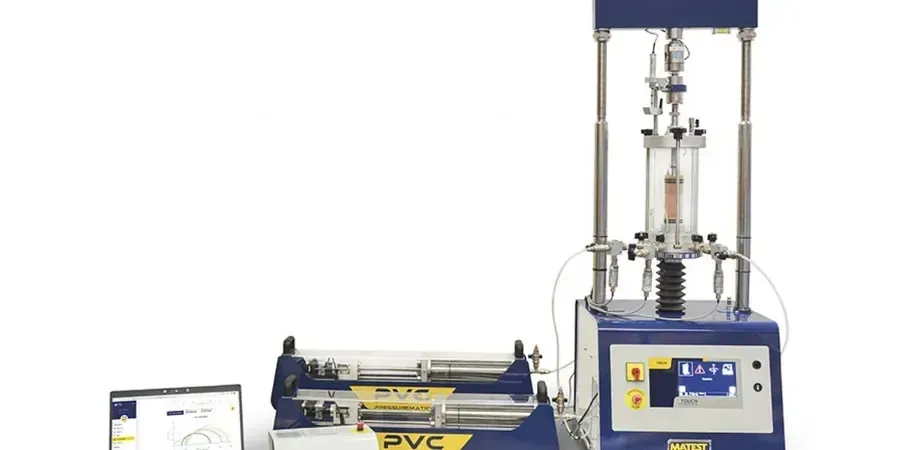
Area-specific notes
A common mistake on Rancho Cucamonga hillside lots is using φ=34° from a generic table for "sandy silt" and calling the retaining wall design done. The Cucamonga fan contains interbedded clayey silts that drain so slowly during construction that undrained strength controls stability, not drained friction. We have seen cut slopes stand through August and fail in November, not because the angle changed, but because negative pore pressures from summer desiccation dissipated after the first rains. A single CU triaxial test with measured pore pressure would have caught it. Another pitfall is running UU tests on samples that dried during transport from Red Hill to the lab, producing cohesion intercepts that do not exist in the field. We trim and test within 48 hours of sampling or reject the tube. The IBC Chapter 18 requirement for site-specific shear strength applies here, and Rancho Cucamonga Building & Safety enforces it on commercial projects.
Standards used
ASTM D4767-11 (Consolidated Undrained Triaxial Compression Test for Cohesive Soils), ASTM D2850-15 (Unconsolidated Undrained Triaxial Compression Test on Cohesive Soils), ASTM D7181-20 (Consolidated Drained Triaxial Compression Test for Soils), IBC 2021 Chapter 18 – Soils and Foundations, ASCE 7-22 Section 12.13 – Foundation Design Requirements
Linked services
Consolidated-Undrained Triaxial with Pore Pressure
We saturate each specimen to B≥0.95, consolidate isotropically to the design effective stress, and shear undrained while recording excess pore pressure with a mid-plane transducer. Output includes c' and φ' in effective-stress Mohr-Coulomb space, the critical-state friction angle, and a stress path plot. Used for cut slope stability, footing bearing capacity on saturated silts, and liquefaction-triggering assessments where effective stress governs.
Unconsolidated-Undrained Triaxial for Short-Term Loading
For projects on low-permeability clays where construction loads apply faster than drainage can occur, we run UU tests per ASTM D2850. The cell pressure is applied without consolidation, and the sample is sheared immediately. The result is an undrained shear strength envelope (Su vs. total stress) used directly in bearing capacity and temporary excavation stability calculations.
Typical parameters
Common questions
How long does a CU triaxial test take from sample arrival to report in Rancho Cucamonga?
A standard consolidated-undrained test with three confining pressures runs five to seven working days. The saturation and consolidation stages alone require 48 to 72 hours for low-permeability silts from the Cucamonga alluvium, and we do not shorten that timeline. Shearing and data reduction add another two days.
What does a triaxial test cost for a Rancho Cucamonga project?
A three-stage CU test with pore-pressure measurement runs between US$1,840 and US$2,740 depending on sample condition, confining pressure range, and whether we need to remold or trim multiple specimens. UU tests fall at the lower end of that range.
Can you run triaxial tests on gravelly soils from the Cucamonga fan?
Specimens with particles larger than 1/6 of the sample diameter require scalping or remolding. We sieve out the +3/4-inch fraction and recompact at the field density to run CU on the matrix. For gravel-dominated layers, we recommend pairing the triaxial program with large-scale direct shear or field CPT correlations.
What saturation check do you use before the shear stage?
We follow the Skempton B-value check per ASTM D4767. The back pressure is ramped until a B-value of at least 0.95 is achieved, measured by applying a cell pressure increment and recording the pore-pressure response. Soils from the Cucamonga area often need back pressures above 500 kPa to reach full saturation due to the low initial moisture content from the arid climate.